The Flag Dispute between Greece and the Republic of Macedonia
Introduction
Official Greece accuses its northern neighbour, the Republic of Macedonia for "stealing the Ancient Greek heritage", which according to the Greek side also includes Ancient Macedonia and its symbols, one of them being the so called Sun of Vergina. The symbol was once used as an emblem on the flag of the Republic of Macedonia, which caused a dispute between the two countries (actually it was an unilateral protest from the Greek side).
Greece is so fast in accusing other nations for "stealing history" that she forgets that she is the one that actually stole a symbol of another nation- an old English flag:
Whoops! Who's the real thief now?
Left: The flag used on the ships of the colonial English Honourable East India Company established in 1600; Right: The modern Greek flag initialy adopted in 1822. So, Greece nicked a foreign flag, changed the colors.. and Voila! We have a flag! Before you disagree, count the number of the stripes, both flags have 9. The Greeks claim that they represent the 9 sylables of their Independence War motto: "Elefteria i Thanatos!" ("Freedom or Death!"). Why should a 17 century English flag also have exactly 9 stripes then? The Greek cross in the canton is evidently stolen from the red English St. George's cross and re-painted in white. Shame...


The East India Company flag changed over time. There has been much debate and discussion regarding the number of stripes on the flag and the order of the stripes. Historical documents and paintings show many variations from nine to thirteen stripes, with some images showing the top stripe being red and others showing the top stripe being white. In any case, its obvious that the whole concept of this flag was stolen by Greece and incorporated in its modern flag.
There's a geographical region in South-Eastern Europe called Macedonia. It was a single geographical entity until the Balkan Wars in 1913 when it was divided between: Greece, Bulgaria, Serbia and Albania. Thats how Greece got its own province of Macedonia (~50% of the whole region), a province especialy rich with Ancient Macedonian history and archaeology. There, the greek government imposed a harsh policy of ethnic cleansing and assimilation against the native ethnic Macedonians, and it also supported a colonisation of Greek refugees from Asia Minor, following the Greek-Turkish War in the 1920's. The part once given to Serbia, later succeded to liberate itself during the antifascist struggle in the WWII and to proclaim itself as the Socialist Republic of Macedonia on August 2nd 1944. However, the other parts of the wider Macedonian region remained under foreign Greek, Bulgarian and Albanian annexation.
That republic became a separate constituent country of the former Tito's Socialist Federal Republic of Yugoslavia (a country- in- a- country). As such, within the communist Yugoslav federation, Macedonia had a statehood, its own government, state symbols, police, territorial army (home guard), Macedonian Academy of sciences and arts, Macedonian Orthodox Church and even a bureau for foreign affairs.
During the breakup of Yugoslavia, it proclaimed independence in September 1991 and it became what is now the independent Republic of Macedonia with capital of Skopje.
The newly independent country was immediatly confronted by Greece. Official Greece denies the existence of a separate Macedonian nation, the existence of a separate ethnic Macedonian minority on its territory, and it perceived its neighbour as a threat to its northern province. Namelly, official Greece claims an exclusive right over the Ancient Macedonian heritage. Important elements of this are: the very name Macedonia and the Ancient Macedonian symbol, the 16-ray Vergina Sun (or Star), found in what is considered the alleged tomb of the king Phillip II, the father of Alexander the Great. Greece doesnt allow the Republic of Macedonia, which also claims relations to the Ancient Macedonia to use them in any way.
Thats why:
Greece, which has its own province of Macedonia demands that the Republic of Macedonia changes it constitutional name (although the UK which has a part called Northern Ireland doesnt demand from the Republic of Ireland to change its name; the US state New Mexico doesnt demand from the country Mexico to change its name).
Greece also demanded from the Republic of Macedonia to change its own national flag, which featured the Vergina Sun, claimed by Greece as a Greek symbol (though Ancient Macedonia was not one of the city-states that comprised the Ancient Greek world, actually it was their worst enemy, just imagine: Jews claiming the nazi swastika as their symbol).
To achieve its goals, official Greece imposed an economic embargo on the Republic of Macedonia in the early 1990's and started a nationalist lobbying campaign both at home and abroad. Then, the Republic of Macedonia followed a policy of peaceful coexistence with its neighbours. During the 1990s, it was the only former Yugoslav country which stayed away from the Yugoslav Wars and was often refered to as The Oasis of Peace.
As a result of the Greek pressure, the Republic of Macedonia was forced to make many concessions to appease its southern neighbour and to prevent a further conflict:
The Republic of Macedonia accepted to join the UN under a provisional name "the former Yugoslav Republic of Macedonia" ( F.Y.R.O.M. )
Certain changes were made to the Macedonian constitution (to show that the country doesnt have any territorial claims to Greece);
The national flag of the Republic of Macedonia with the Vergina Sun was replaced with a new different flag
The president Kiro Gligorov had to give a statement that the modern ethnic Macedonians are descendents of the Slavs who arrived in the Balkans in the 6th century, and who have nothing in common with Ancient Macedonia.
However, despite accepting to be named FYROM in the UN, the Republic of Macedonia rejected to change its constitutional name for domestic use, and for billateral use with those countries who do not object it. Thats how the Republic of Macedonia was recognized under its constitutional name by the USA, Canada, Russian Federation, People's Republic of China, Turkey and many other countries.
The Flag dispute
Its claimed that the Ancient Macedonians often used a stylized depiction of a sunburst (or a starburst) as their symbol. It can be seen with 16, 8 or 12 sun rays on many archaeological artefacts. Sometimes it can also include a rosette decoration in the middle. One of the most popular version of this symbol is the 16 rayed Sun of Vergina, found on the larnax (coffin) which allegedly contained the remains of King Phillip II. The Vergina Sun is claimed as a historical symbol by both the Republic of Macedonia and Greece, which both also claim relation to the Ancient Macedonians. However, Greece demands full exclusive right to the Ancient Macedonian heritage and doesnt want to share it with anyone else. As a result, the two countries have a long term unresolved dispute.
In 1992, the newly independent Republic of Macedonia adopted a new flag which included the 16-ray Vergina Sun (on a red backround), which led to protests from official Greece. Under Greek pressure, in 1995 it was replaced with the current flag of the Republic of Macedonia, which includes a different stylized form of a sun.

Flag of the Republic of Macedonia (1992-1995)
Its important to note that the sun symbol was often featured in the old folklore art of the ethnic Macedonians, on their historical flags and other artefacts, and even on the coat of arms of the Socialist Republic of Macedonia, which includes a rising sun with 8 visible rays (the other 8 from the Vergina Sun being hidden behind the mountain).
Traditional ethnic Macedonian folk art
Traditional ethnic Macedonian jewerly
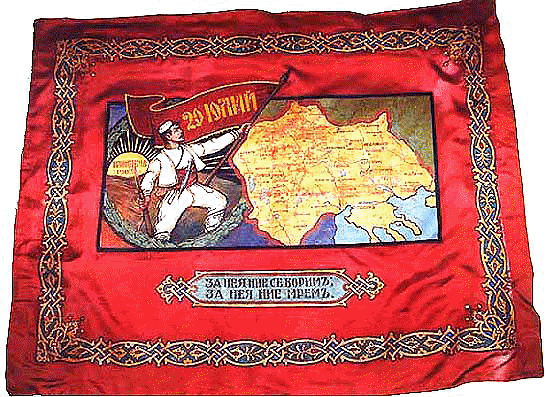
CLICK TO ENLARGE: Left: flag of the emigrant ethnic Macedonian revolutionary society in St. Petersburg, Russia, 1914 feat. Alexander's horse Buchephalos, represented as an unicorn according to the old legend, and a sun symbol in the bottom left angle; Right: Insurgent flag against the Ottoman rule, 1903 feat. a sun symbol on the left.
The Coat of Arms initialy adopted for the Socialist Republic of Macedonia after WWII. Still in official use in the Republic of Macedonia.
The main Greek rationale for the flag dispute was that the Sun of Vergina is allegedly a greek symbol, and that its use by the Republic of Macedonia is an act of stealing of the ancient greek heritage. Moreover, the Greek side emphasised the fact that the symbol was discovered on its territory.

King Philip's larnax
However, Greece forgot to mention that her share of the whole Macedonian region was forcibly annexed by her armies in the Balkan Wars in 1913. Prior to that, the territory has never belonged to Greece.
Also, its very important to mention that later, this symbol was also discovered on many archaeological artefacts found in the southern parts of the Republic of Macedonia, which were too part of the Ancient Macedonian Kingdom- a fact deliberately ignored by Greece, which continously repeats that: "There is only ONE Macedonia, and its in Greece".
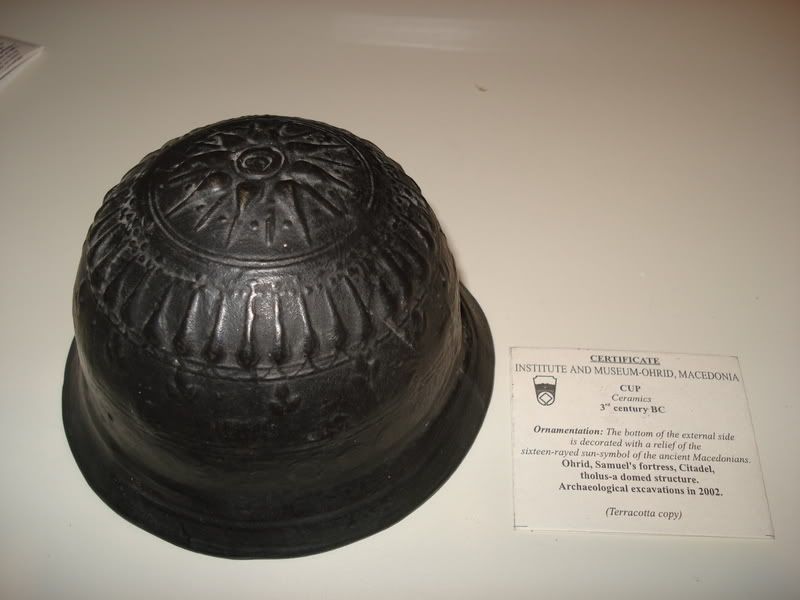
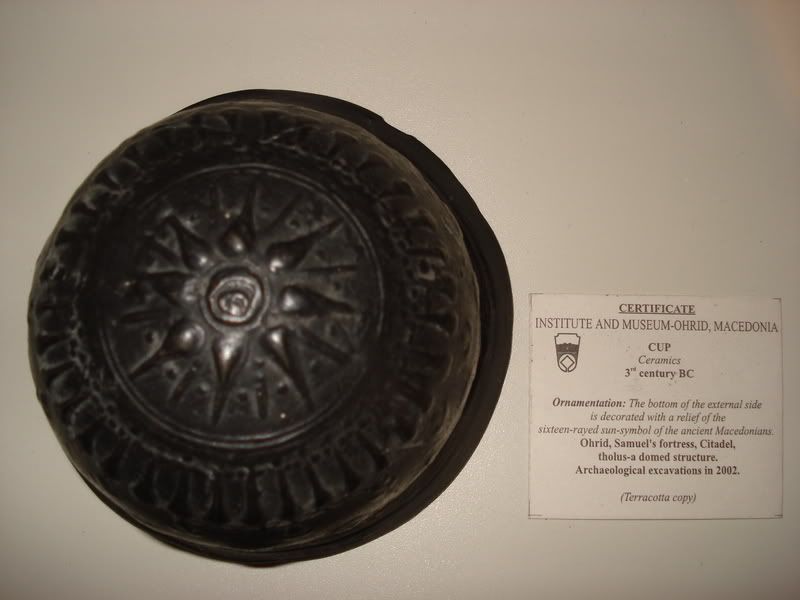
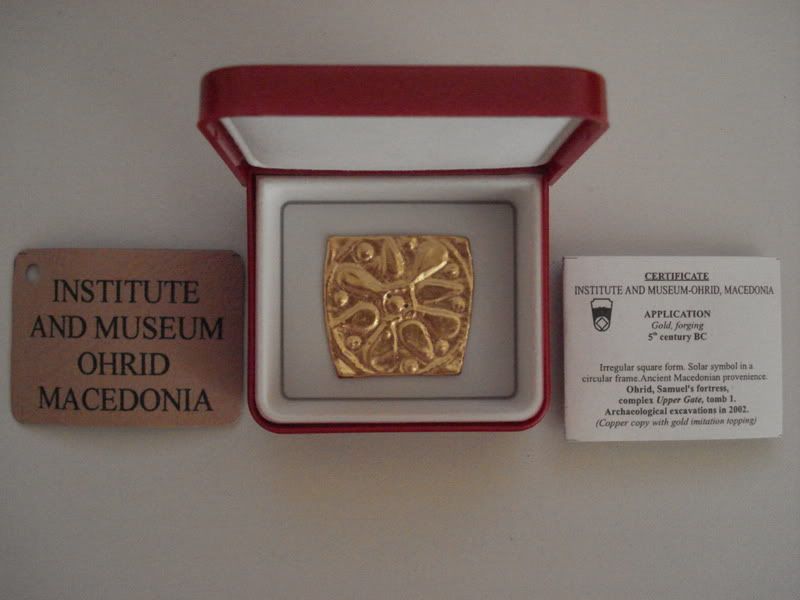
CLICK TO ENLARGE: Certified museum copies of archaeological artefacts featuring the Ancient Macedonian Sun/Star symbol (known as the Vergina Sun), excavated in Ohrid, a city of a great historical and cultural significance once belonging to the Ancient Macedonian Kingdom, situated on the Ohrid Lake in the Republic of Macedonia. Shall we call the symbol the Sun of Ohrid from now on?
Another important, but dubious Greek claim is that the symbol was firstly discovered during the excavations of the Ancient Macedonian Royal Tombs of Aigai, in the village of Vergina in Greek Macedonia, by prof. Manolis Andronikos in 1977. Some Greeks may agree that the symbol may have been known prior to that, but just as an artistic ornament without any historical significance. According to them, only after the discovery of the Royal Tombs, the true nature of this symbol was discovered- its an Ancient Macedonian royal emblem.
An entertaining twist in this story is that they dont know (or dont want to know) that the symbol actually appeared publicly all around the globe decades before 1977. It was featured in its 8 ray version on the shields of the Ancient Macedonian warriors in the 1956 epic film Alexander The Great starring Richard Burton. Its an American movie, quite pro-Greek biased, so it cannot be accused of advocating the Republic of Macedonia's point of view.

Screenshot: Richard Burton sporting the Vergina Sun in Alexander The Great, 21 years before prof. Andronikos "discovered" it
How come the Greeks are not aware that this symbol was internationaly recognized as an Ancient Macedonian royal or state emblem far before the prof. Andronikos' discovery in 1977? The symbol that he "discovered" has been already used by the ethnic Macedonians for centuries, as we explained above. For the Greeks, until 1977, this symbol was largely (or completely) unknown.
But anyway, Greece continues to claim an exclusive right to it. It even registered it in the World Intellectual Property Organization and finally, in 1993 it placed it on the newly created flag of its own Macedonian province, but on a blue backround.

Flag of the Greek province of Macedonia
However, almost 20 years since the start of this dispute, official Greece fails to explain: how come that many countries use same symbols on their flags, but they dont confront eachother because of that:
Same sun symbol in different variations on the both flags. Its called the Sun of May, a representation of the Inca sun god Inti, and a bizzare fact is that it has 16 sunrays, exactly same number as the Vergina Sun. It appeared publicly for a first time on Argentinian coins in 1813. An additional bizzare thing is that, the flag of Uruguay features 9 alternating blue/ white stripes, exactly the same number and color as on the modern Greek flag ("Eleferia i Thanatos"?!). So should Argentina now sue Uruguay over "stealing" its sun symbol? Or should Greece sue Uruguay over the blue/white stripes? Or to sue them both over the "stolen" 16 rayed sun symbol?! You may say well, two neighbouring South American nations, they both have a right to claim the pre-Colombian heritage although they speak Spanish today. Good. Accordingly, can the modern ethnic Macedonians, considered Slavic by the Greeks, use the Vergina Sun then?


- Almost all of the Nordic countries use the Nordic Cross
It was initially used on the Danish flag- the Dannebrog, and was later incorporated in the flags of: Norway, Iceland, Sweden and Finland. Can Greece explain, how come that Denmark doesnt object the use of this symbol by its Scandinavian neighbours? Isn't it a "stealing of the Danish history"? Some may say that these nations are ethnicaly or historicaly interrelated, so maybe thats why they use a same symbol. That can be only a partially accepted explanation, because the Finns are not related to their Germanic neighbours, but to the Finno-Ugric peoples like the Hungarians. Also, historicaly, until proclaiming its independence, Finland was under Russian domination, and today is the only republic in a region filled with monarchies. Basically, Finland has very little incommon with Denmark, but still, it uses a symbol taken from the Dannebrog, the Danish national pride since the Middle Ages!
- Poland, Indonesia and Monaco
The whole "difference" between these flags is: between Poland and Inonesia- the order of the colors, and between Indonesia and Monaco only the the ratio. Basically, completely same flags of three completely unrelated nations.
- Republic of Ireland and the African country Ivory Coast
The sole "difference" seems to be the order of the colors and the ratio. Same flags. Unrelated nations.
Both England and Georgia use the red Cross of St. George on a white backround. The difference is that the Georgians have added 4 additonal smaller crosses around it. Otherwise- same. Unrelated nations. The English flag was inspired by the flag of Genoa (Italians, prepare a lawsuit! ;-)).
- The Czech Republic and Philipines
Similar design. Unrelated nations.
- USA, Liberia and Malaysia
Same stripes, same blue field in the upper left corner and even the star(s) are here. The Afro-American and the Liberian populations are indeed related, but what Malaysia has incommon with them? Should the US now sue Malaysia over stealing its national pride- The Stripes, which symbolize the 13 American colonies that rebeled against the British Crown?
- United Kingdom and the Autonomous Basque community within Spain
The flag of the United Kingdom, the Union Jack features the 3 crosses: The red Cross of St. George from the English flag; the white St.Andrew's cross from the Scottish flag and the red St. Patrick's cross from the old Irish flag. Only the Welsh Red Dragon is missing. The design of the Basque flag was based on the Union Jack. Should the Queen Elizabeth II sue them now?
- Chile and the US state of Texas
Almost same flags.
Hold on, hold on! Did I just said the US STATE of Hawaii? How come that a federal unit of a country which once fought for independence against the Brits is now using the Union Jack?? Where are the Greeks now to protest the Hawaiian "stealing" of British heritage? Hawaii is not a British colony or a protectorate or a dominion or an overseas territory or whatever. Its part of the United States of America.
And there are milions of other examples...
So why all these countries dont just sue eachother for "stealing" eachother's history and culture? (if we follow the offical Greek "logical" way of thinking)
IMPORTANT NOTE: All those flags (with the exception of the Basque, the Texan and the Hawaiian flags) are flags of internationaly recognized independent countries. Yet, these flags have never been a cause of any international dispute. The flag of the Greek province of Macedonia has a much lower importance than them because it is a flag of a a geographical and historical province and not of an independent country. Moreover, the flag of Greek Macedonia has no historical significance. It was adopted recently just as a retaliation against the Republic of Macedonia.
Contrary to that, all those nations listed above were fighting wars, conquering other countries and achieveing sport successes under those flag symbols for centuries. For them those symbols have a huge historical and national significance. Still, as you can see, they have absolutely no problem to share those symbols with other nations, unlike Greece which is jealously possesive over the Vergina Sun, although the symbol is most probably not Greek at all. Under that symbol King Philip and his son Alexander were killing Athenian soldiers and conquering and burning the greek city-states. What a paradox.
But anyway, Greece continues to make such a great fuss about it. The hysteria goes so far, that sometimes the Greek nationalists even forget their real national flag: the well-known one with the blue and white stripes and the cross in the upper left angle.
Instead, they give so much importance to a recently adopted flag of a geographical province:
Since the flag dispute with the Republic of Macedonia began, the Vergina Sun suddenly started to appear everyewhere in Northern Greece: on governmental buildings and offices; at celebrations and political meetings; on various documents, military insignia, tourist souvenirs and even everyday products such as hotel soaps, sugar bags and bus tickets (hopefuly not on condoms and toilet paper too, but everything's possible in a country where unfortunatelly, the extreme nationalism is an everyday fact).

100 Drachma coins (the former Greek currency later replaced by the euro)

Hellenic Armed Forces arm patch

Greek sugar bags (author: cakesniffer)
So after all this, we have a full right to ask: How come all those countries are allowed to have almost same flag designs only with minor differences, while at the same time, the Republic of Macedonia was not allowed to keep its 16-ray sun symbol?
Wasn't the red backround sufficient enough to differentiate it from the Greek blue version?
Even if we decide to beleive in the official Greek claim that the modern ethnic Macedonians are not descendants of the Ancient Macedonians, but Slavs, still, this sun symbol was found in Ohrid in present-day Republic of Macedonia, so this country has every right to use it, in a same way that the modern Arabic Egyptians have nothing incommon with the Ancient pharaos, but still they are proudly promoting their country with the pyramids and the sphynx.
Greece should finally get rid of its blind ultra chauvinism once and for all. We need peace, stability and cooperation in the Balkans.
Извор: http://vbb.blog.com.mk
-------------------------------------------------------------------------------------------------
Tags: Ελληνική Δημοκρατία Μακεδονία Πρώην Γιουγκοσλαβική Δημοκρατία της Μακεδονίας Ελλάδα Σημαία Ήλιος της Βεργίνας Βεργίνα Θεσσαλονίκη Καβάλα Σέρρες Κατερίνη Βέροια Δράμα Κοζάνη Πτολεμαΐδα Γιαννιτσά Νάουσα Έδεσσα Κιλκίς Καστοριά Φλώρινα Αλεξάνδρεια Γρεβενά Χρυσούπολη Άργος Ορεστικό Λιτόχωρο Πολύγυρος Μανώλης Ανδρόνικος Βαλκάνια Αθήνα ΝΑΤΟ ΠΓΔΜ όνομα Αλέξανδρος ο Μέγας Φίλιππος Β' ο Μακεδών Χρυσή Λάρνακα Πέλλα Σκόπια βέτο Μακεδόνες Ελευθερία ή θάνατος Κωνσταντίνος Αλεξάνδρου Καραμανλής Ντόρα Μπακογιάννη Νέα Δημοκρατία Πανελλήνιο Σοσιαλιστικό Κίνημα Κομμουνιστικό Κόμμα Ελλάδας Ελληνικός Εμφύλιος


.jpg)